Sunspots are observable manifestations of the Sun's magnetic field. The Sun is close to us
compared to other stars in the Universe. This means that with a telescope, we can see the dark
sunspot features in much more detail than a star that is both fainter and much farther away.
What if we want to learn about the magnetic field of other stars? A lot less is known about these
stars, and the tools with which to learn about them are more limited. A technique that is used by
astronomers to circumvent this problem is using transiting planets as a probe. The Kepler spacecraft
monitors the brightness of stars and detects orbiting planets through an apparent dip in the
brightness when a planet crosses in front of the star. Planets sometimes cross in front of
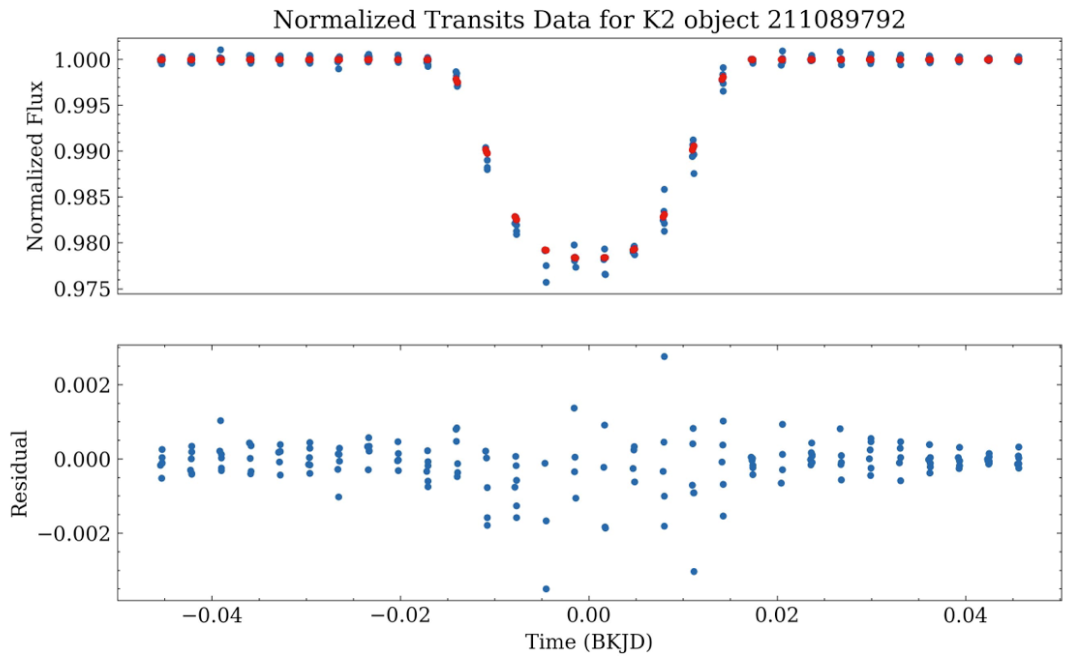
starspots on the star; this has a unique effect on the dip in brightness. The planet is now blocking
less light, so there are bumps in the dip of the brightness. Therefore, analyzing in-transit
variation of brightness of stars can help identify objects with starspot crossing events.
The goal of this project is to identify objects with starspot crossing features from a list of K2
candidates. The planet samples are obtained from Campaigns 1-8 and 10-18 of the K2 mission
(Zink et al., 2021). Given an object, the program extracts its long cadence lightcurve data from the
Kepler/K2 catalogs of the Mikulski Archive for Space Telescopes (MAST), normalizes individual transits,
and computes a model based on its stellar parameters using BAsic Transit Model cAlculatioN in
Python (batman). The program then calculates the difference between the data and the model and
performs the Kolmogorov-Smirnov (K-S) test on the residuals to determine whether they are
statistically from different distributions. Out of 196 objects, 10 objects are identified by visual
inspection of their lightcurves to have starspot crossing features. These objects have K-S statistics
ranging from 0.15 to 0.39. By compiling a short list of objects with starspot crossing features, this
allows for further study on these stars.