
Recent Project and Papers | Starspot Modeling with STSPOver the past several years, I have been using a novel technique that allows for measuring the positions and sizes of starspots on the surfaces of distant stars. Since Sunspots are known to be the location of strong concentrations of magnetic fields on the Sun, individual starspots can be used as tracers of the underlying local magnetic fields on stars. I have completed the development of a modeling program called STarSPot, or STSP for short, designed to determine the latitude, longitude, and radius of small-scale starspots on any transiting planet host star that shows the effect of in-transit starspots. The program is based on the following concept: a transiting planet causes a dip in brightness in the light curve of a star when the planet passes in front of the star and blocks stellar light that would otherwise be observed. If the surface brightness of the star is not uniform due to magnetic surface features like cool starspots or hot plage, the in-transit light curve will not be smooth and symmetric. An increase in brightness that appears as a ``bump'' in the bottom of the transit indicates that the planet is briefly blocking less light from the star because it is crossing in front of a starspot that is cooler and, thus, darker than the surrounding surface. Importantly, the precise knowledge of the planet's position (as derived from the shape and timing of the transit light curve) provides specific positional information about the spots in the path of the planet. |
Modeling Stellar Surface Features on a Subgiant Star with an M-dwarf Companion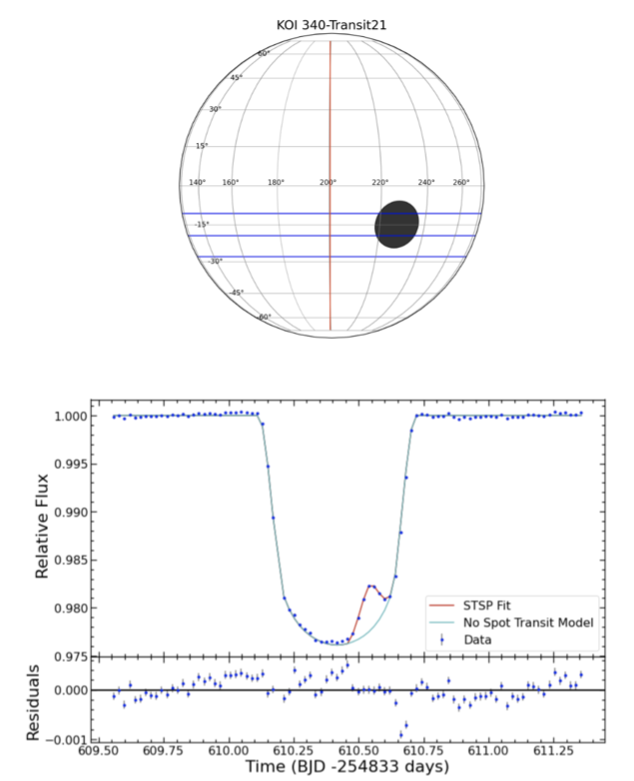
Maria Schutte and I used the STSP program to solve for the positions and sizes of the starspots on the star, KOI-340. KOI-340 is an slightly evolved subgiant star about twice the size of the Sun. We find the starspots on this star to be on average four the size of Sunspots in physical radius. In addition, at least 15% of the detected starspots are larger than the largest spot ever observed on the Sun. Finally, the total spot coverage of the star at any point in time is 10 times that of the Sun. These measurements indicate that KOI-340 has stronger and more numerous magnetic fields emerging on its surface than the Sun does. We speculate that this is due to the increased convection zone of the star as it expands and evolves off the main sequence. |
An In-depth Look at TOI-3884b: A Super-Neptune Transiting an M4Dwarf with Persistent Starspot Crossings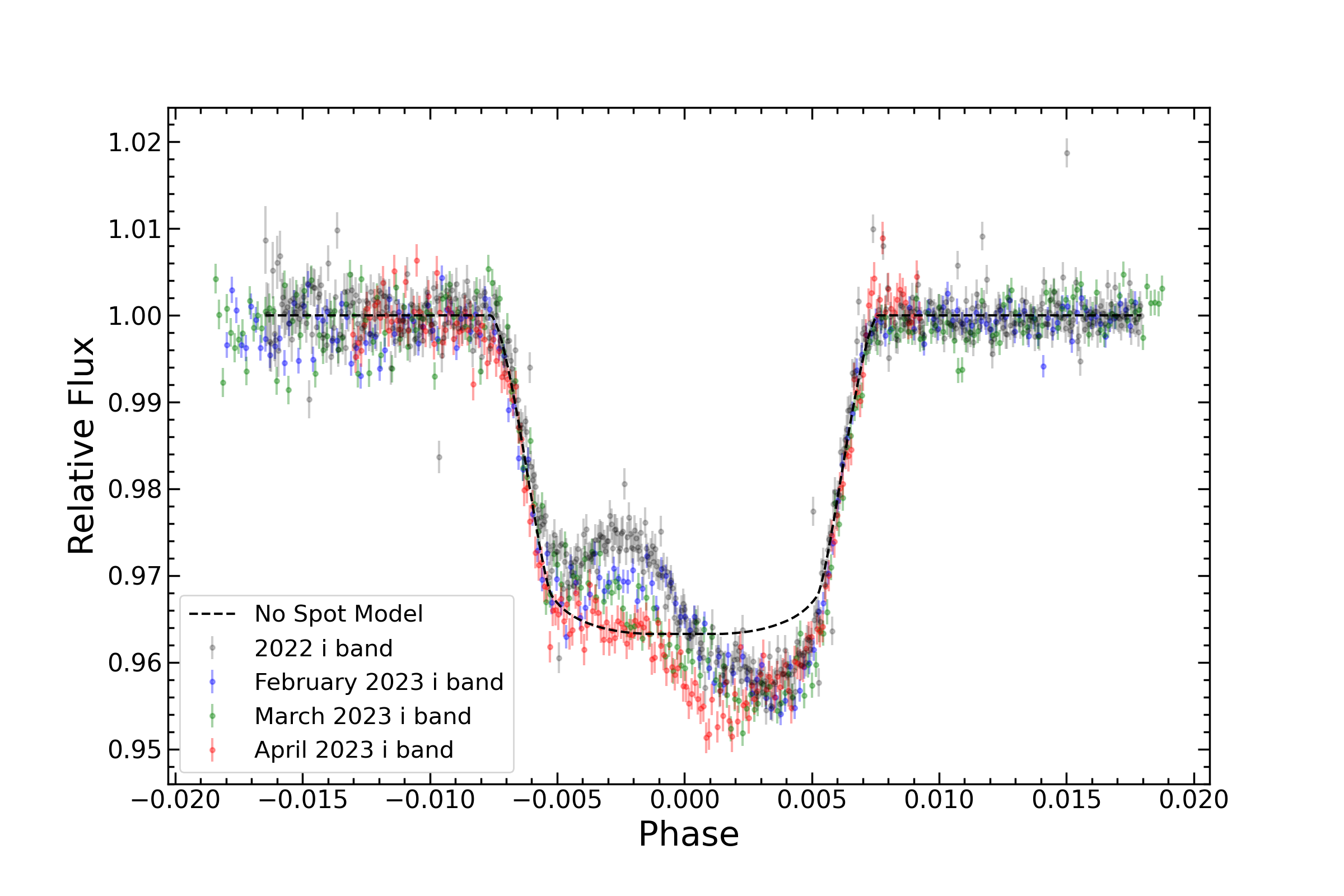
We identified a new transiting planet, TOI-3884, that showed a large persistent starspot crossing feature in every TESS transit light curve between March 2020 and June 2022. While spot occultations are often detected in multiple, different transits of the same star, TOI-3884 is unique in that the feature persists at the same orbital phase in the first half of the transit for at least two years. The similarity of the amplitude, duration, and shape of the features combined with its persistence suggests that we are observing the same long-lived spot in all the lightcurves. The consistent phase of the spot feature indicates that star is tilted away from the line of sight and the large starspot is fixed at or near the pole so that it doesn't move relative to the observer even as the star rotates. The best fitting model suggests a large starspot (with a size of 29% of the radius of the star) fixed on the southern pole is causing the main feature. In addition, the rotation axis of the star must be tilted back by 25° so that the southern pole becomes visible, and the orbital axis of the planet cannot be aligned with the rotation axis of the star (as is the case in the solar system and many other planetary systems) in order to create a feature that is offset from the middle of the transit. We find the projected angle between the spin axis of the star and the orbital axis of the planet to be lambda = 75°. |
The Starspots of HAT-P-11: Evidence for a Solar-like Dynamo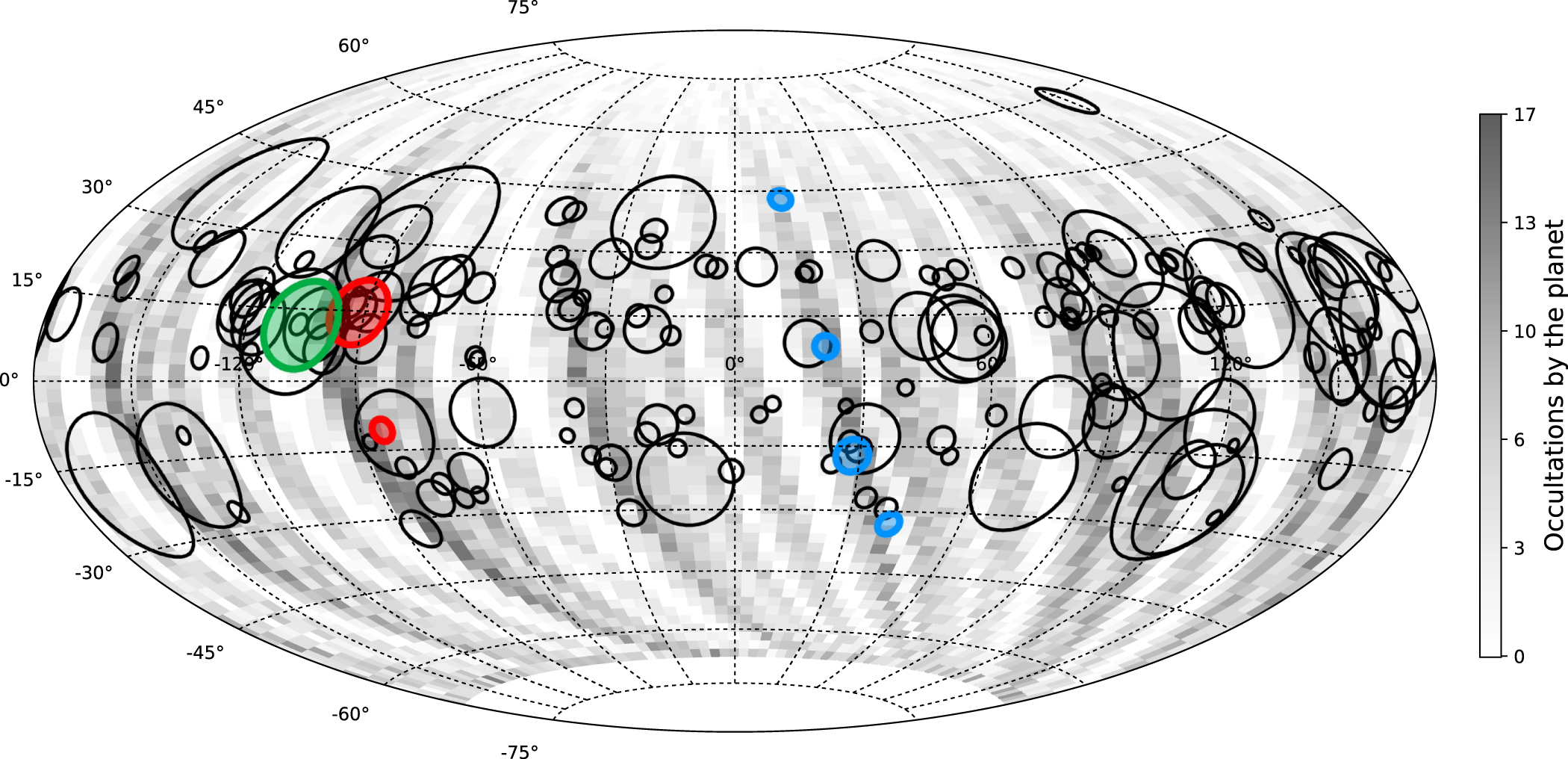
We measure the starspot radii and latitude distribution on the K4 dwarf HAT-P-11 from Kepler short-cadence photometry. We take advantage of starspot occultations by HAT-P-11's highly misaligned planet to compare the spot size and latitude distributions to those of sunspots. We find that HAT-P-11's spots are distributed in latitude much like sunspots near the solar activity maximum, with a mean spot latitude of 16°. The majority of HAT-P-11's starspots have physical sizes that closely resemble the sizes of sunspots at solar maximum. We estimate the mean spotted area coverage on HAT-P-11 to be, roughly two orders of magnitude greater than the typical solar spotted area. |