Tibetan Sand Mandala
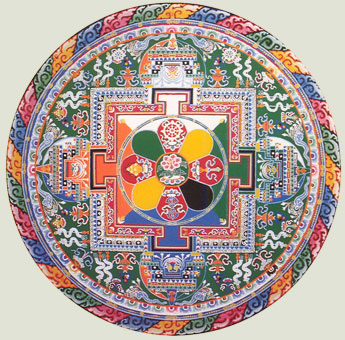
A mandala is a cosmic diagram that represents the dwelling place or celestial mansion of a deity. Both the deity, who reside in the mandala and the mandala itself are recognized as pure expressions of Buddha's fully enlightened mind. Mandala can be visualized, painted or constructed from wood, precious jewels, rice, flower and so forth. Sand is considered to be a superb medium because of its number and the great skill required to create the mandala's exquisite details.
According to Tibetan Buddhist history, the purpose, meaning and the techniques involved in the spiritual art of the sand mandala painting were taught by Buddha Sakyamuni in the 6th century B. C. in India. Mandalas are created for rituals of initiation and for meditations; it is also created to purify the environment and its inhabitants to promote harmony in the world.
Five levels of essences that can be taken from practice of Mandala.
- For the advanced Buddhist tantric practitioner, Mandala is used where one receives initiations from ritual masters to preform rituals of visualizations that include invocation of the deities, making offerings and purifications etc. It is the place where you transform your ordinary state of mind into an enlightened mind.
- For the intermediate level, Mandala serves as a toll for spiritual development such as Love, Compassion, Patience, Humility, Self Discipline, Contentment and Wisdom to overcome negative emotions such as Hatred, Impatience, Ego, Undisciplined mind, Greed and Ignorance to promote ethical life.
- For the beginner, Mandala serves as an object of Meditation to develop mental stability and clarity to reduce anxiety, frustration, worry and stress etc. It is a method to remind us to live in the present moment.
- For the artist, Mandala is an ancient Tibetan art that has many fascinating unique qualities such as background history, meanings and purposes that reflect value of our life and remind us to live happy and let other live happy too. It is also part of cultural offering to the rest of the world from Tibet.
- Mandala is also used to purify and bless the people and the world from negative forces and to bring harmony and peace to the world. It is to remind us of the importance of educating the heart to become a warm hearted good human being to reduce man made problems that came from selfish narrow minded and greedy attitudes.
Creation Process
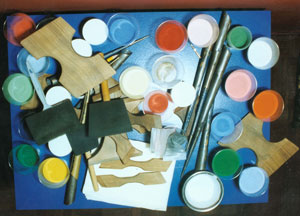
The artist will chant before starting the mandala creation. Then the blue print of the mandala's design is outlined and the artist begins constructing the mandala from the center to outward. The colored sand is applied through a long metal funnel, called Chakpu. Since sand mandalas are created in the spirit of impermanence and non attachment, after they are completed, they are dismantled with a ceremony and the blessed sand is offered to the body of water for the benefit of marine life, the environment and all sentient beings.
About The Artist
The Venerable Lama Tenzin Yignyen is an ordained Tibetan Buddhist
monk. He holds a degree of "Master of Sutra and Tantra" studies from the
Namgyal Monastery of His Holiness the Dalai Lama in Dharamsala, India.
Lama Tenzin taught Tibetan Buddhism, art and language at Namgyal branch
monastery in Ithaca, N.Y. for three years. He has created sand mandalas
in many museums and educational institutions throughout the United
States including the Cleveland Museum of Art in Ohio, The Natural
History Museum of Los Angeles, Rochester Memorial Art Gallery, and the
Asia Society in New York City. Lama Tenzin currently lives in Geneva,
N.Y. and is a visiting professor for Tibetan Buddhism at Hobart and
William Smith Colleges.
More information
Some Past Mandala Art Exhibitions:
2015
Poly Prep School, Brooklyn, NY
Friends Academy, Long Island, NY
Yellow Knife, Canada
FLCC Canandaigua, NY
Iolani School, Honolulu, HI
Bard College, Anandale, NY
Fairport School, Rochester, NY
Tucker School, Boston, MA
2014
Massart, Boston, MA
Harley School, Rochester, NY
Peace Weaver Event, Bath, NY
Val Morin Yoga Ashram, Montreal, Canada
2013
Harley School, Rochester, NY
Ross School, East Hampton, NY
Bard College, Anandale, NY
MVCC, Utica, NY
Massart, Boston, MA
Iolani School, Honolulu, HI
2012
TED Event, CA
Masters School, NY
Harley School, Rochester, NY
Peace Weaver Event, Bath, NY
Val Morin Yoga Ashram, Montreal, Canada
Phoenix House, East Hampton, NY
Ecofest, New York, NY
Massart, Boston, MA
Clark University, NY
Nazareth College, Rochester, NY
2011
Campbell Hall School, CA
Saint Andrew School, FL
Bard College, Anandale, NY
East Hampton School, NY
Chapin Girl’s School, New York, NY
The Berkeley Carrol School, Brooklyn, NY
2010
Horace Mann School, N.Y.
Nazareth College, Rochester, N.Y.
Harley School, Rochester, N.Y.
Peaceweaver
Mass. College of Art and Design
EcoFest, New York City
Keuka College, N.Y.
2009
Mohawk Community College, N.Y.
MIT, Boston, Mass.
Child Development School
Dalton School
Val Morin Yoga Center, Canada
2008
St. Andrew's, Boac Raton, Fla.
Tibet House, New York City
Colgate University, N.Y.
Ross School, East Hampton, N.Y.
Campbell Hall School, Calif.
2007
Strong National Museum of Play, Rochester, N.Y.
Masters School, N.Y.
Fenn School
Ross School
FLCC, N.Y.
Riverdale, N.Y.
Londonderry, Pa.
2006
Harley School, Rochester, N.Y.
St. John's Nursing Home, Rochester, N.Y.
Morris School, South Hampton
Finger Lakes Community College, Canandaigua, N.Y.
Yoga Ashram, Nassua, Bahamas
Peaceweavers , Bath, N.Y.
EcoFest, New York City
AAAC, N.Y.
Hobart & William Smith Colleges, Geneva, N.Y.
2005
Yoga Ashram, Canada
Yoga Ashram, Nassua, Bahamas
Morris Central School, South Hampton
Brearly Girl's School, New York City
Putney School, Putney, Vt.
St. Lawrence University, Canton, N.Y.
Hobart & William Smith Colleges, Geneva, N.Y.
India Tour with 20 students - Fall term
2004
Putney School, Putney, Vt.
Finger Lakes Community College, Canandaigua, N.Y.
Katonah Museum, N.Y.
MIT, Boston, Mass.
Bard College, N.Y.
Horace Mann School, N.Y.
Lincoln Center, N.Y.
Dalton School, New York City
2003
Bard College, N.Y.
Sivananda Yoga Ashram, Grass Valley, San Francisco, Calif.
Yoga Center, Montreal Canada
2002
Yoga Ashram, Nassua, Bahamas
Union College, N.J.
Riverdale School, N.Y.
CIA, Durango, Colo.
Grass Valley Yoga Center, Calif.
Adirondack Lake Art Museum, Blue Mountain Lake, N.Y.
Peaceweavers , Bath, N.Y.
2001
Dalton School, New York City
CMA, Cleveland, Ohio
Peaceweavers , Bath, N.Y.
Hammond Museum, N.Y.
Wagner College, Staten Island, New York City
2000
Smithsonian Festival in Washington, D.C.
AAAC in New York City
Amitabha Foundation, Rochester, N.Y.
Tibetan Museum of Art, Staten Island, N.Y.
1999
St. Lawrence University in Canton, N.Y.
Rotunda Art Gallery and NY/ Newseum in New York City
Hobart and William Smith Colleges, Geneva, N.Y.
Cleveland Institute of Arts, Cleveland, Ohio
1998
Horace Mann, Poly-Prep and New Dorp high schools in New York City
Hobart and William Smith Colleges, Geneva, N.Y.
1997
Cleveland Museum of Art, Cleveland, Ohio
Asia Society, New York City
Memorial Art Gallery, Rochester, N.Y.
Universal Studio, Los Angeles, Calif.
1994
Gandan Monastary in UB Mongolia
1989
Wind Star Foundation, Aspen Colo.
Natural History Museum of Los Angeles, Calif.