Sub-Neptune exoplanets, planets with radii between Earth and Neptune, represent the most common
class of exoplanets in our galaxy. Yet, their composition and formation histories remain poorly
understood. Unlike the terrestrial or gas giant planets of our solar system, sub-Neptunes have
uncertain interior structure properties. This presents a major modeling challenge: multiple
compositions can produce the same mass and radius, a problem known as compositional degeneracy.
Although thousands of sub-Neptunes have been discovered, most existing models struggle to resolve
this degeneracy. Many rely on oversimplified assumptions, such as isothermal interiors or stratified,
unmixed volatile layers, and often neglect constraints from atmospheric observations. As a result, key
questions remain unanswered: What is the true compositional diversity of sub-Neptunes? Are they
water-rich, hydrogen-rich, a combination of sub-populations, or something else? How do these objects
form and evolve?
This study addresses these challenges by developing interior structure models that incorporate
temperature-dependent equations of state, isothermal-adiabatic thermal profiles, and mixed H/He-H2O
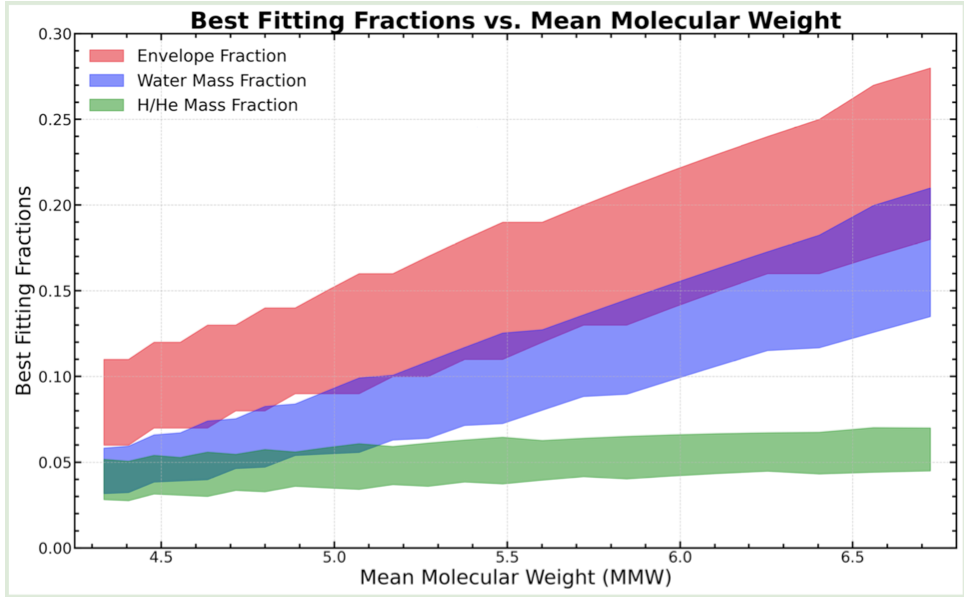
envelopes. Importantly, this work connects interior structure models to observable quantities such as
atmospheric mean molec- ular weight (MMW), enabling direct comparison with JWST spectral retrievals.
The analysis begins with TOI-270d, a well-characterized sub-Neptune with new JWST constraints, and
expands to a broader population of planets selected for upcoming or ongoing atmospheric observations.
Through this combined case- study and population-level approach, the goal is to demonstrate that
detailed interior structure modeling-when done carefully-can yield meaningful insights into planetary
composition, even in the absence of detailed atmospheric spectra. As high-precision observations become
more common, frameworks like this will be essential for interpreting the growing diversity of small
exoplanets.