About Math 131
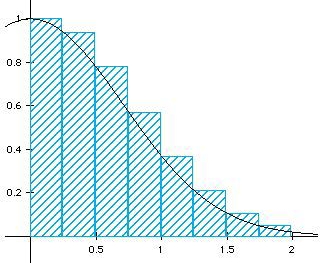
First-year calculus is usually divided into two parts (terms): differential calculus and integral calculus. Briefly, differential calculus is concerned with rates of change ("the slope problem") and integral calculus is concerned with area, in particular the area in the plane enclosed by arbitrary curves. The Fundamental Theorem of Calculus shows how these different concerns are essentially the two faces of a single coin. Having completed a "tour" of differential calculus, you are now prepared to focus on integral calculus.To prove the Fundamental Theorem of Calculus requires us to connect the process of antidifferentiation to the notion of area under a curve. You know how to find the areas of some regions: squares, rectangles, triangles, and circles. While you might be able to justify the area formula for a rectangle, it is unlikely that you could give a satisfactory proof for the area formula of a circle. In fact, there is a more fundamental problem here: What is area?
 In differential calculus, the motivating problem was the paradoxical notion of an
"instantaneous" rate of change. What do we mean by speed "at an instant?" Average rates or
speeds are familiar ideas: divide distance by time. But in an instant, no time passes and
no distance is
travelled. So there is no (rate of) change! We resolved the paradox by using average
rates of change over smaller and smaller time intervals. In the end, the instantaneous
rate of change (or derivative) was defined to be the limit of average
rates of change. But note, the concept of an "instantaneous" rate had to be defined
through a fairly long process and was not "obvious."
In differential calculus, the motivating problem was the paradoxical notion of an
"instantaneous" rate of change. What do we mean by speed "at an instant?" Average rates or
speeds are familiar ideas: divide distance by time. But in an instant, no time passes and
no distance is
travelled. So there is no (rate of) change! We resolved the paradox by using average
rates of change over smaller and smaller time intervals. In the end, the instantaneous
rate of change (or derivative) was defined to be the limit of average
rates of change. But note, the concept of an "instantaneous" rate had to be defined
through a fairly long process and was not "obvious."
In the same way, area, though familiar, is not an obvious notion. Some area formulas are familiar, but what is area? What are its defining characteristics? We will start with this problem and see that its solution has a wide variety of applications. In learning how to find area, we will also learn how to find or define the length of a curve, the volume of a solid, the work done by a force applied over a distance, and so on.
As with derivatives, limits will be crucial to the solution of the "integral" or area
problem. This time the "paradox" will be that we add up lots (i.e., an infinite
number in the limit) of small areas (0-sized in the limit) to obtain the area of a
figure. There are lots of questions to resolve: How do you add an infinite number of
things? How do you divide a region up into smaller pieces whose areas you know? Answers
to such questions will motivate our "definition" of area.
Goals and Outcomes
You should think of Calculus I and II as a tightly linked sequence of questions and ideas. There are several goals for the Math 130 and 131 sequence. On the theory side these include: (1) displaying familiarity with the key steps in the development of the derivative and the integral by using two different notions of the limit, (2) displaying a familiarity with the fundamental relation between the integral and the derivative, and (3) displaying an understanding of the main theoretical results of the subject (e.g., the Mean Value Theorem and the Fundamental Theorems of Calculus). On the practical side, objectives include (1) classifying functions (e.g., those having limits, continuous, differentiable, or integrable), (2) classifying the critical points of functions and applying this classification to solve extremization problems, (3) interpreting the meaning of the derivative and the integral, (4) displaying a knowledge of basic differentiation and integration techniques, (5) adapting known techniques (e.g., finding areas under curves) to new situations (e.g., finding volumes or lengths of curves), (6) justifying through written work the application of theorems and techniques to particular problem-solving situations.Text and Notes
The Briggs & Cochran text for this course is concise and readable. It focuses on the concepts of calculus, not just the algebraic and formulaic manipulations. The central ideas or theorems of the course require justification or "proof." Though this course will not be overly theoretical, there are several arguments or proofs that I want you to understand. I will help you with them, but carefully read through them in the text. The text is very "readable" so please spend lots of time with it! Long after most of you have forgotten the "rules of integration," I hope you still remember what the process of integration is and how it is used.
I also intend to put some notes on line that are based on my class lectures. These will
have additional examples and problems to try. Look for them at our course website.
Labs
Every Thursday our section will meet for a problem solving laboratory. Attendance is required. These labs are an excellent time for you to ask questions about the course material. Bring your notes. Most students find lab sessions very helpful. For the last 10-15 minutes of some labs, there may be an open book, open note quiz based on the work you have done that day. Selected problems from each lab may be collected and graded.Assessment
Homework, reading, and practice exercises will be assigned at the beginning of each class. I encourage working in small groups on practice problems. This can be very helpful in understanding the material.Once (or twice a week), there will be an assignment consisting of selected problems to hand in for grading. In the past, I have insisted that graded assignments are to be your own work without collaboration. But this term, I will try something different. You may discuss graded homework assignments with others. Verbalizing your questions, explaining your mathematical ideas, and listening to others will increase your understanding. BUT you are not free to simply copy others' work or to make your work available in this way to others. You will be heavily penalized for such instances. Make sure you write up your answers on your own. Plagiarism acts against my obligation as an instructor to insist that students do work that will benefit them and help them think and learn independently. I reserve the right to change this policy if it is abused. (Note: Other faculty will have different policies about homework.) Your work will be due at the beginning of the next class. It should be neat and done in pencil. If more than one page is required, please staple them. No late assignments, please.
There will be regular, graded WebWork computer exercises that review the material and concepts we are currently covering. You will get immediate feedback from these exercises that will allow you to assess your progress. Further, if you submit an incorrect answer, you may return to the problem and work on it again until you get it right. Students typically earn 90-100% on this part of the course. Though every student's problems will be similar, they will not be identical to each other. You may find these problems frustrating at first because you will have to be quite careful in entering your answers. Stick with it! Using WeBWorK will mean that there are fewer or shorter written assignments.
I may also use a few announced 10-minute quizzes to check your progress.
There will be three in-class tests and a final exam. The dates are listed in the outline below. Tests will be cumulative but will concentrate on more recent material. It is impossible to construct fair makeup exams in mathematics. For your own protection, my policy is that there are no makeup examinations. If for some extraordinary reason you find you are unable to take an exam, let me know as soon as possible, certainly well before the exam is administered.
Your course grade will be calculated as follows. First I will make a list of your grades:
Note: The final is listed twice. Next, I will remove the lowest score. If the final is your lowest grade, it is removed just once. Then I will average the remaining five grades. I reserve the right to take class participation into account.
Extra Credit: You may earn extra credit
by attending a Mathematics and Computer Science Department seminar
and writing up a brief half-page reaction to it.
You may recieve a maximum of three such credits.
Attendance and Courtesy
Because of the nature of this course, its assignments, and its assessment, your attendance and participation is crucial. Mathematics is learned by regular, sustained, attentive effort over an extended period. Only when such effort has been invested will the concentrated study for an exam have any benefit. Therefore, attendance at class and lab is required. If you must miss a class for some reason beyond your control, talk to me about it in advance. More than three unexcused absences will affect your grade as follows.- Each of the fourth, fifth, and sixth absences will result in a deduction of 3, 4, and 5 points, respectively, from your final grade.
- Beyond six absences will likely result in your expulsion from the course.
- On the plus side, if you miss 0, 1, or 2 classes I will add 1.5, 1, or 0.5 points, respectively, to your final grade as a participation bonus.
Finally, common courtesy demands that you be on time for class and that
you do not leave the room during class (unless you are ill). This will help you, your
classmates, and me to give our full attention to the course.
Expectations and Prerequisites
Calculus I is a prerequisite for this course. If you did not pass Math 130 or its equivalent with a grade of C- or better, this course is inappropriate for you and you should see me immediately. Success in Math 131 requires a solid understanding of differential calculus. I assume you understand how to use the notions of limit and derivative and are familiar with their applications and interpretations. You should be familiar with l'Hopital's rule and basic antidifferentiation, as in Sections 4.7 and 4.8 of the text. If you are concerned about your background, see me immediately!
I expect that you will put in at least two to three hours of work outside of class for each hour
in class, including lab. This includes reading the text, reviewing class notes,
finishing lab problems, doing
practice problems, and then doing assigned homework problems. This effort will be rewarded by making the
exams seem easy.
Math Intern
The Math Intern, Dave Brown, is available in Lansing 310 for extra help in the late afternoon and the evenings. His office hours are listed at the beginning of this document. Please utilize this extra resource.Tips for Success
Here are a few simple things that you can do to be more successful in the course.- Come to all classes. Take complete and careful notes.
- Do the readings and practice problems carefully.
- Keep the answers to problems and notes on the readings in a journal.
- Review/recopy the notes from the last class before coming to class again. This makes studying for a test easy.
- Start homework and WeBWorK assignments early.
- Come in for help whenever you need it, preferably before you get too far behind.
- Visit the Math Intern for help in the evenings.
- Review the notes I place online at the course website.
- Review some of the lab questions once a week.
- Ask questions in class. Ask questions about the homework and readings.
Outline of Weekly Readings
This assumes a fairly rapid pace through the listed material. This schedule will be adjusted based on our work in class.- Week 1: The Area Problem, Summation Notation. 5.1. On you own: Review 4.7-4.8 (L'Hopital's Rule, Antiderivatives) and the Mean Value Theorem (page 276; make sure you understand Figures 4.68 and 4.69).
- Week 2: Riemann Sums and the Definite Integral. Chapter 5.2.
- Week 3: The Fundamental Theorem of Calculus. Properties of Integrals. Chapter 5.3-5.4.
- Week 4: Integrals via Substitution. Chapter 5.5. Application: Change in Position. Chapter 5.5, 6.1
- Week 5. Area Between Curves, Volume by Slicing. 6.3.
- Thursday, February 16: First Hour Test (in Lab).
- Week 6: Applications: Volume by Shells. Arc Length. Chapter 6.4. 6.5.
- Week 7: Application: Work. Log and Exponential Functions, again. Chapter 6.6(pp 423-426), 6.7.
- Week 8: Integration by Parts. Trig Integrals (briefly). Chapter 7.1, 7.2.
- Week 9: Trig (Triangle) Substitution. Chapter 7.3, and Handout.
- Friday, March 16: Second Hour Test. 7:40 am?? and 9:40 am??
- Week 10: Partial Fractions (briefly). Improper Integrals. Chapter 7.4, 7.7.
- Week 11: Sequences and Series. Chapter 8.1, 8.2, 8.3.
- Week 12: Series, the Divergence Test, and the Integral Test. Chapter 8.3, 8.4.
- Week 13: Convergence Tests, Alternating Series. Chapter 8.5-8.6.
- April 19: Third Hour Test (in Lab).
- Week 14: Power Series and Taylor Series. Chapter 9.2-9.3.
- Week 15: McLaurin and Taylor series. Chapter 9.3.
- Final Exam. Section 01: Saturday, May 5, 2012. 1:30PM; Section 02: Monday, May 7, 2012 at 8:30AM.