BD 219: Mathematical Models and Biological Systems


Offered:     Spring 1998
Instructors: James M. Ryan (Biology)
             Kevin J. Mitchell (Mathematics)
Room:        Napier 101 and Rosenberg 009
Time:        T-TH: 9:00 to 10:45 AM
Readings:    "The Pace of Life" by Bruce King
             Mathematicial Models of Biological Systems by Mitchell, Ryan, and Kolmes
             "Game Theory" by Kenneth Prestwich


Information Available:


About the Course

This course is especially appropriate for those with an interest in science and mathematics. Historically, mathematics has been used extensively in the other sciences (and social sciences) to describe, explain, and ultimately predict the behavior of complex systems. In this course we will discuss and implement the major facets of mathematical modeling using examples from the biological sciences. These include: a) examining underlying assumptions, b) translating the "real world" into mathematics, c) generating testable predictions, d) generalizing models to new or different situations, and e) examining the fit between the mathematics employed and the underlying system being modeled. The course will include field trips to the Hanley Preserve for data collection. It culminates in carrying out and reporting on a major field project of the student's own design. The course is cross-listed in the Environmental Studies Program and, with permission, may count towards either a biology or mathematics major.

The course supposes no particular background in either mathematics or biology beyond a normal high school education. We will develop the mathematical tools that we will need to use during the course. Biological material will be provided as we proceed through the various units. What we do suppose is that you will be interested and active participants in our learning endeavor!

In particular, we will use examples of biological systems to give an "exploded view" of the modeling processes: simplifying and idealizing the original system, translating the idealized system into mathematics, "solving" the resulting problem or system of equations, and translating "solutions" back to the biological world. We examine the appropriateness of particular kinds of mathematical techniques for certain types of problems and we discuss the possibilities and problems of generalizing the models we build. We emphasize the "translation processes" among the real biological world, an idealized biological world, and the mathematical world.

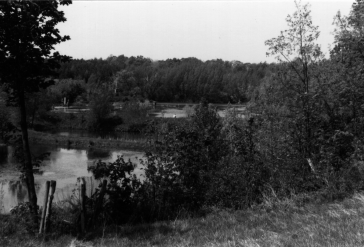
This is one of the many ponds at the Hanley Nature Preserve which is owned by the Colleges. It is about a 20 minute drive from campus. We will make three field trips here to collect data for the course.

Course Topics


We will work through the material and projects in the course in the following order:
  1. The Pace of Life: an introduction to modeling
  2. The Species--Area Relation: an introduction to problem of species distribution
  3. Information Theory: a tool for measuring ecological or behavioral diversity
  4. Field research at the Hanley Preserve the Colleges' biological field station and selection of topic for independent project and term paper
  5. Optimal Foraging: how animals decide what to eat
  6. Game Theory: animal behaviorial strategies in the competition for scarce resources


    Assessment

    There will be frequently assigned exercises. Some exercises will be done in class in a group or with a partner, others will be assigned for you to complete outside of class and to turn in as a written report. Some of the exercises will involve using the computers in the Macintosh Lab in Rosenberg Hall. We hope that this will make certain calculations and simulations easier and more interesting.

    The course culminates in an individual, field-based project designed by the student and which requires a substantial (10 pages or more) written report in the form of a scientific paper and class presentation. A series of exercises and smaller projects throughout the term familiarize you with the particulars of writing a scientific paper (e.g., abstract, introduction, materials and methods, results, and discussion sections).

    Final grades for the course will be based on: (a) class exercises, (b) individual exercises, (c) project proposal presentation, (d) field work, and (e) class participation. The term paper will count for approximately 33% of the final grade. As a general policy, no late materials will be accepted. Finally, attendance at all class meetings and field trips is required. Failure to attend more than two classes will adversely affect your grade in the course.

    A note on field work. Three class periods will be spent doing field work at the Hanley Preserve. The tentative dates are: April 22nd, May 4th, and May 25th. Please mark them on your calendar. Because the Preserve is a 20 minute drive from campus, it will require meeting for class at 7:15 am on the mornings of the field trips. This will permit us to carry out our work and return for the next class period on campus.

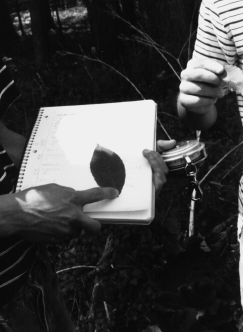
    Here students collect leaf-height data for a final project on biodiversity.


    Course Fee

    The readings for the course consist of the UMAP Module "The Pace of Life: An Introduction to Empirical Model Fitting" by Bruce King and the text Mathematicial Models of Biological Systems by Mitchell, Ryan, and Kolmes. Included in this text is "Game Theory" by Kenneth Prestwich. All materials will be passed out in class. There is a $25 course fee for these materials, software, and other course materials which has been assessed to your college account.

    The course will be demanding, exciting, and unusual. We think that it will be an interesting experience. Welcome aboard!


    Game Theory Resources

    Visit Kenneth Prestwich's extensive site on Game Theory and Evolutionarily Stable Strategies.

    You can download his material in .pdf format here.

    Your computer must be equipped with Adobe Acrobat Reader (tm) which you can obtain free here.

    Student Projects


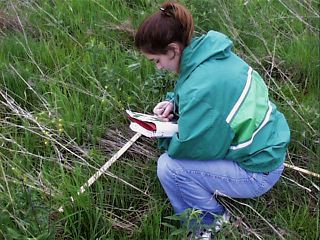
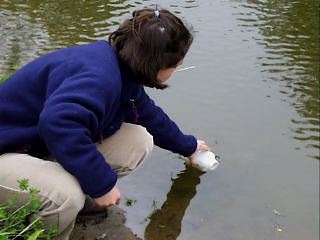
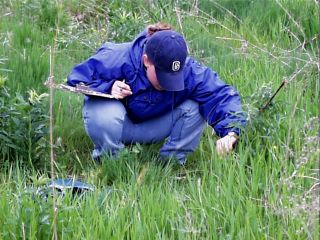
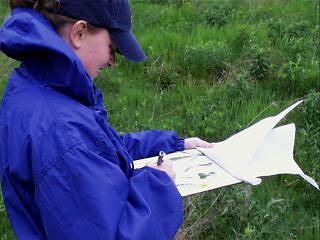
    (Left) Carrie Davis collects a plankton sample from a pond at the Hanley Presevre for a study on diversity by pond size and location. (Right) Christina Smith collects species-area data for a project comparing diversity in fields that have lain fallow for different lengths of time. (Hanley Presevre: 25 May 1999)
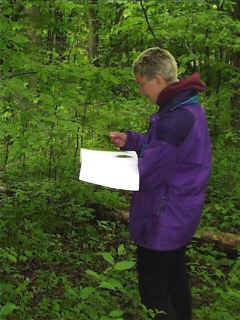
    Kate Young collects and records plant species diversity data for a study of the effects of mowing and other factors on diversity in fields. (Hanley Presevre: 25 May 1999)
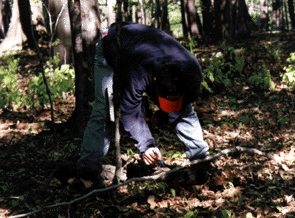
    (Left) Amber Beutel collects data in a wooded area of the Hanley Preserve (25 May 1999) for a project on tree-species diversity in natural and disturbed environments. (Right) Dan Phillips collects data for a study on the species-area relationship under decomposing logs in deciduous forests (Hanley Preserve: 27 May 1997).


    Outline of Topics by Class

    1. Introduction; What is a Model?
      • Course mechanics.
      • The modeling process.
      • Bornstein & Bornstein: "The Pace of Life," Nature Vol. 259, February 19, 1976; pages 558--559.
      • Reading: King. "The Pace of Life: An Introduction to Empirical Model Fitting." UMAP Unit 551, Sections 1--3 and "Transforming Functions" handout.
    2. Modeling the pace of life.
      • Population and Physiology.
      • Field guide to basic functions: Graphs of lines and curves.
      • Transforming data sets: Data Analysis Lab 1 using Graphical Analysis .
      • Field Exercise 1: Pace Data Project Assigned.
      • Reading: King. "The Pace of Life." UMAP Unit 551; Sections 4--5.
    3. Completion of the pace model.
      • Pace data discussed.
      • Alternate modeling functions.
      • Discussion of "Materials and Methods" sections of papers.
      • Reading: Handouts on "The Species--Area Relation."
    4. The Species--Area Relation.
      • Introduction to the species--area concept.
      • Introduction to the species--area concept.
      • Examples.
      • Methods of fitting curves to data.
    5. Applications of the Species--Area Concept.
      • An in depth look at some uses of the this model.
      • Difficulties with the the model.
      • Discussion of "Results" sections of papers.
      • Reading: Kolmes & Mitchell. "Information Theory and Biological Diversity." UMAP Unit 693, Sections 1--3.
    6. Introduction to Information Theory and Biological Diversity.
      • What is diversity: Examples, intuition, and basic characteristics.
      • A mathematical measure of diversity.
      • Reading: "Information Theory and Biological Diversity," Sections 4--5.
      • Data collection: Samples of texts in various languages.
    7. Information Theory: Theory and Selected Examples.
      • Why does H1max = log (n)?
      • Applications of information theory.
      • Assignment of final projects.
      • Lab Exercise: Letter diversity as a function of language.
      • Due: Results from Field Exercise 2.
      • Reading: Kolmes & Mitchell. "Second-Order Information Theory and Biological Diversity," Sections 1--3.
    8. Field Exercise 2: The Plant Diversity of Field, Pond Edge, and Forest.
      • Data collection at the Hanley Preserve.
      • Reading: Mitchell, Ryan, & Kolmes. "Second-Order Information Theory and Biological Diversity," Sections 1--3.
    9. Introduction to Second-Order Information Theory.
      • Probability and (causally) independent events.
      • Second-order calculations.
      • Student Migration (License Plate and/or Catalog) Project.
      • Due: Results from Field Exercise 3.
      • Reading: Finish "Second-Order Information Theory and Biological Diversity."
    10. Second-Order Information Theory Applications.
      • Exmaples second-order information theory in ecology and animal behavior.
      • Preparation for Field Exercise 3.
      • Assignment and discussion of final project proposals.
    11. Field Exercise 3: Plant Diversity by Height Zone.
      • Data collection at the Hanley Preserve.
      • Reading: Mitchell, Ryan, & Kolmes. "Optimal Foraging Theory." Sections 1--3.
    12. Introduction to Optimal Foraging Theory (OFT).
      • Assumptions and basic definitions in OFT.
      • Intuitive introduction to the model.
      • Calculating encounter rates and profitabilities.
      • Reading: "Optimal Foraging Theory," Sections 4--5.
      • Due: Materials and Methods section for Pace Data Exercise.
    13. Calculating Optimal Diet Breadth.
      • Decision "rules" for optimal foragers.
      • The effects of prey density.
      • Werner and Hall's test of the model.
      • Reading: "Optimal Foraging Theory," Sections 6--7.
    14. Student Presentation of Project Proposals.
      • Brief presentations of the proposals for your final projects.
      • Feedback from students and faculty on the proposals.
      • Revision of project proposals due 17 May 1999 at 9 am.
    15. Extending the Optimal Foraging Model: Recognition Time and Patches.
      • New assumptions: The problem and effects of recognition time.
      • Altering the measure of profitability.
      • Reapplying the decision "rules" for optimal foragers.
      • New assumptions: Patchy habitats.
      • Reading: "Optimal Foraging Theory," Sections 7--8.
    16. Extending the Optimal Foraging Model: Patches and Central Place Foragers.
      • Altering the model: calculus and the optimal forager.
      • New assumptions: Central Place Foragers (CPF).
      • Critiquing the model.
      • Reading: Kolmes & Mitchell, "Time Resources in Animals," UMAP Unit 688, Sections 1--3.
    17. Field Exercise 5: Data Collection for Final Projects.
      • Data collection at field site.
      • Reading: Prestwich, "Game Theory."
    18. Introduction to Game Theory.
      • Anaysis of Pairwise Games
      • Evolutionary Stable Strategies
      • Hawks and Doves

      • Reading:"Prestwich, "Game Theory" Chapters 1--3.
    19. More on Game Theory.
      • The Haewks and Doves Simulation
      • The Bourgeios Strategy
      • Reading:"Prestwich, Chapters 4--6.
    20. More on Game Theory.
      • Wars of Attrition
      • Reading:"Prestwich, Chapters 7--8.
    21. Submission and Discussion of Projects and Course Evaluation During Exam Period: Tuesday, June 8 from 7:00 to 10:00 PM.


    Office Hours

    James M. Ryan
    Department of Biology
    Eaton Hall 210     Extension 3601
    E-mail:            ryan@hws.edu
    Office Hours:      TWR 11:00--12:00
    
    Kevin J. Mitchell 
    Department of Mathematics and Computer Science
    Lansing Hall 305   Extension 3619
    E-mail:            mitchell@hws.edu
    Office Hours:      MW 2:30--3:30, TT 12:30--1:30
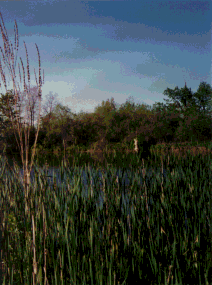
    

    Another of the ponds at the Hanley Nature Preserve.


    This document last updated on 24 February 1999. Send comments to: mitchell@hws.edu.